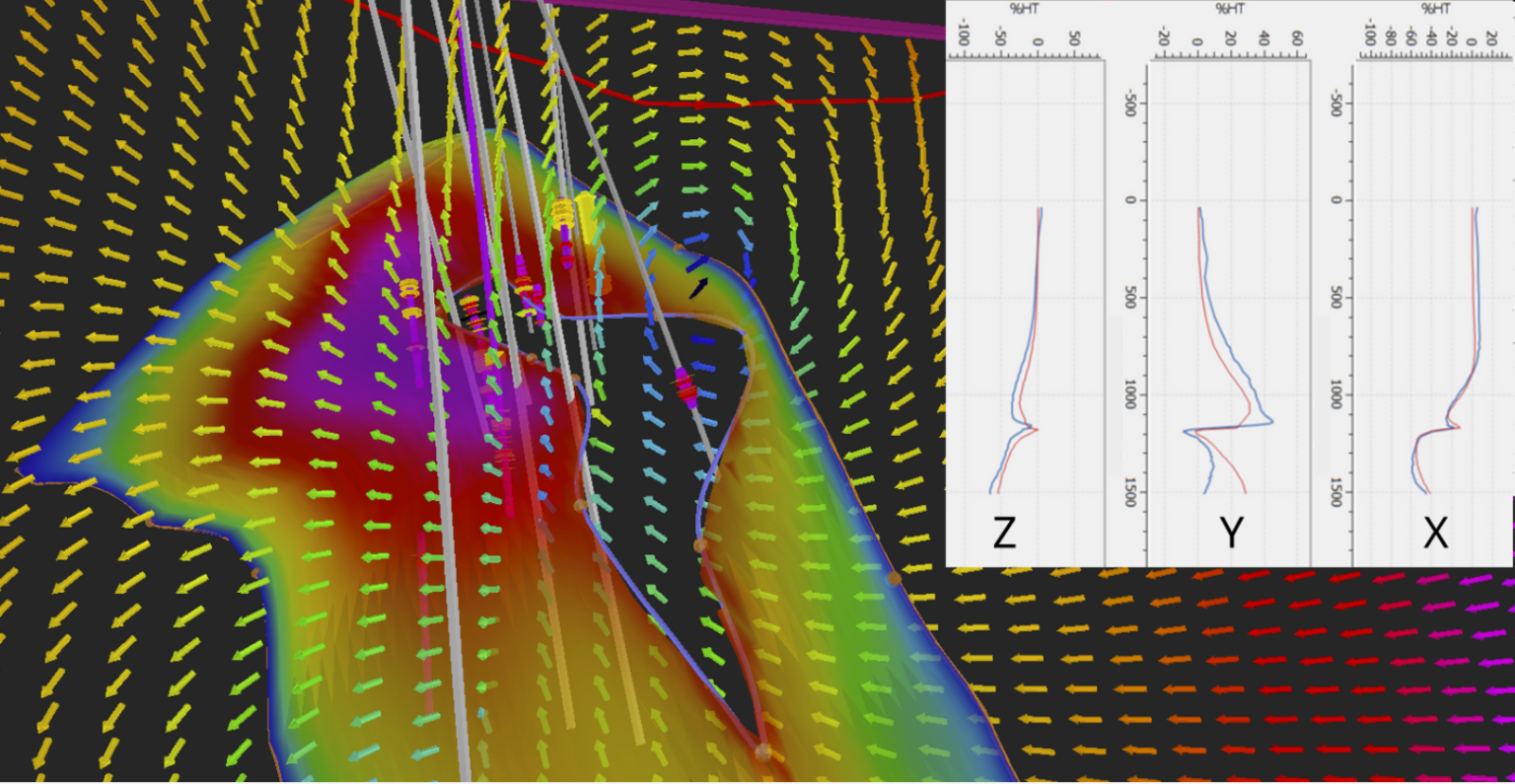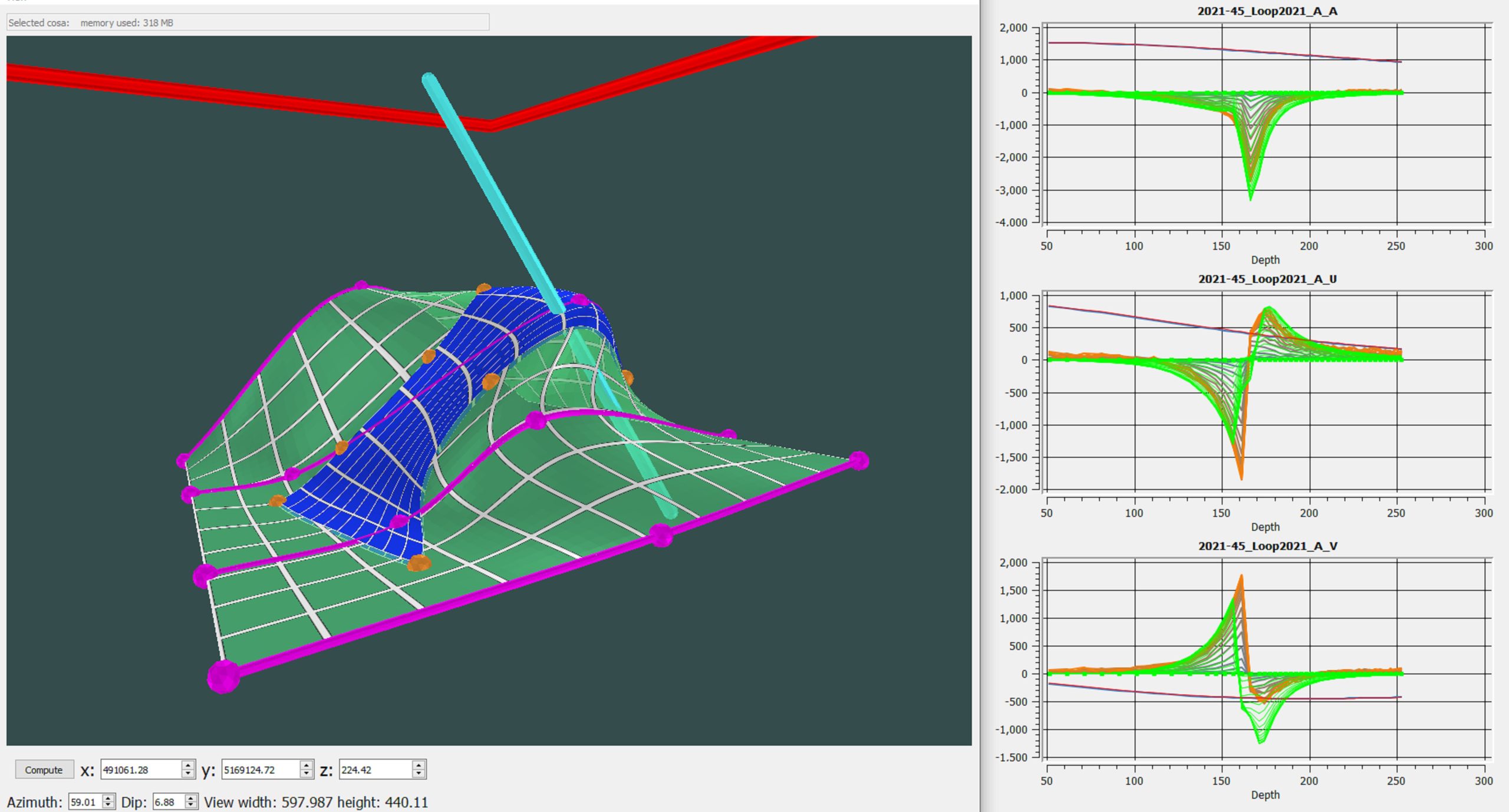
Advanced EM modelling for complex geology.
At the heart of Provus is a unique and powerful approach to EM simulation. Instead of relying on traditional, rigid plate models or complex triangulated meshes, Provus utilizes Structured Deformable Sheets.
Easily define conductors of any shape. Each conductor is defined by two sets of controls: one for the surface and another for the conductor's form within that surface. Model multiple conductors simultaneously with accurate mutual interactions.
Import and forward model with existing .pte files. The "GA Link" in Provus allows users to import data from Geoscience Analyst to Provus and vice versa.
Provus simulation requests are exceptionally fast, allowing for rapid iteration and testing. Users can adjust the number of modes for a conductor, balancing accuracy with computation time to suit their specific needs.
Provus provides easy creation and manipulation of conductors of complex shape. Each conductor is defined by one set of control points/lines defining the surface in which the conductor exists and by a second set of control points defining the conductor locus within that surface. The control points can be moved by dragging or keyboard commands, resulting in a fluid, easy interface for creating and modifying complex shapes.
The shape of the Provus Ribbon Conductor can be further modified by the use of masking functions, allowing for the definition of more complex conductor boundaries as well as the introduction of voids (or holes) within the locus of the conductor.
Provus supports rectangular plate modelling. Initiate a plate model or load it from a Maxwell ".pte" file. Manipulate the plate interactively and co-simulate with other plates and/or Provus conductors. Promote a plate to a Provus conductor and begin to deform it into more complex shapes.
Provus conductors can be of any smooth shape and consist of a conductor of complex shape induced by a transmitter loop or dipole carrying a specified current waveform. The technique uses a vector potential formulation, decomposed as a set of trial functions for the surface current density into a set of eigencurrents, each with an exponential decay. The trial functions operate over the surface of the conductor and utilize "ribbon model solutions." The set of trial functions is general enough to handle large gradients in the primary field excitation. The eddy currents are thus free to evolve correctly even when the primary field reverses direction across its surface.
Unlike "Ribbon Models#4" that limit the induced current to flow in a concentric pattern, Provus uses a 2D harmonic series in a rectangular domain mapped to a 2D complex conductor object. Using this "complete" set of basis functions allows Provus to represent eddy current diffusion more accurately in situations where the conductor is near or under the loop or where the coupling changes over the surface of a curved surface.
In this example, Provus has been used to create a conductive plunging waveform truncated by the surface. A transmitter loop straddles the low edge, creating two areas on the conductor surface that are reverse coupled to one another. The eddy currents are essentially "pulled" outward to either side of the loop axis. The early time step response shows a figure eight current system reflecting the opposite coupling. As time progresses, the diffusion of the currents forces the one with the highest total early time moment, so that at late time the eddy current becomes unipolar.
In this example, a small part of the conductor sticks up near the surface and is strongly energized by the transmitter loop. This area supplies the dominant centre of the eddy current vortex at early delay times (blue). At later times, the center of the current vortex migrates to the larger, deeper part of the conductor.
EM modelling requires the user to explore model conductor shapes, locations, and attitudes to obtain a match between field observations and simulated responses. Provus combines easy modification of conductor geometry, fast simulation computation, and sophisticated plotting to help the interpreter define an optimal model. This process is made more efficient by the use of parametric inversion on the locations of the conductor model control points. Each computed model and model response is stored in a cache for later review and is cached based on RMS data misfit.
Try using Provus for your next project at no cost with a limited time demo license. You can acquire a full Provus license on a subscription basis or leverage the expertise of our team by using Novaminex's consulting services to model your EM data.